

If you manage a commercial building in Auckland, high-frequency water monitoring is the fastest way to cut your water bill, because you are paying for almost every litre twice. Watercare charges you for the water that comes in and again for the wastewater that goes out, and from 1 July 2026 both rose another 7.2 per cent. Reading a meter once a month tells you what you already spent. Monitoring water at 15-minute or hourly intervals tells you where it is leaking, running after hours, or being wasted, while you can still do something about it.
For facility and property managers running Auckland assets, water is now a cost worth watching closely, and many buildings are quietly wasting thousands of dollars a year.
In this post
- Why Auckland is New Zealand’s highest-cost water market
- What is high-frequency commercial water monitoring
- How high-frequency monitoring finds savings a monthly meter read never will
- Two Auckland examples: what monitoring caught
- The wastewater trap most Auckland buildings walk into
- How BraveGen captures water data across a portfolio
- Frequently asked questions
Why is Auckland the highest-cost commercial water market in New Zealand?
Auckland is the country’s largest metropolitan water network, run by Watercare, and its commercial charges are among the steepest in New Zealand. The reason is structural: you pay on both sides of the meter.
For the 2026/27 year, Watercare’s commercial charges (excluding GST) are:
| Charge | Rate (excl GST) | What it covers |
|---|---|---|
| Water supply (volumetric) | $2.14 per 1,000 litres (kL) | Every litre delivered to your meter |
| Wastewater (moderate user plan, volumetric) | $6.61 per kL | Collecting and treating what goes down the drain |
| Wastewater fixed charge (moderate user) | $776.85 per year, per meter | Maintaining the network |
The number that surprises most facility managers is that wastewater costs roughly three times more than the water itself. And for a standard commercial premise such as an office, Watercare bills wastewater on 95 per cent of the water you are supplied, on the assumption that only 5 per cent does not reach the drain.
Put those together and a typical Auckland office pays about $8.40 per kL (excl GST) all-in: $2.14 for the water in, plus roughly $6.28 for the wastewater out. Including GST that is close to $9.70 for every 1,000 litres. That is the “in and out” cost, and it means every litre you waste is charged nearly twice over.
It also keeps climbing. Watercare is running a $13.8 billion, ten-year infrastructure programme, around $3.8 million a day, and has signalled ongoing annual increases. Water is no longer a rounding error on a commercial building’s operating budget.
What is high-frequency commercial water monitoring?
High-frequency commercial water monitoring means capturing consumption data at short intervals, typically every 15 minutes or hourly, rather than reading a meter monthly or quarterly. Instead of a single number on an invoice, you get a continuous flow profile for the building. It is sometimes called interval metering, smart water metering, or continuous water monitoring. The point is simple: you see a problem when it starts, not when the bill arrives weeks later.
A building that is empty overnight and on weekends should drop close to zero flow. When it does not, that flat “baseline” of continuous consumption is almost always a leak, a stuck valve, a faulty cistern, or a cooling tower or irrigation system running when it should not be. A monthly read blends all of that into one figure you cannot act on. Interval data exposes it within a day.
How does high-frequency monitoring find savings a monthly meter read never will?
Four patterns show up almost immediately once you can see water use by the hour:
- Overnight baseline flow. Any continuous consumption between roughly 11pm and 5am in a building that should be empty is waste. Catching a single running toilet or underground leak can save tens of thousands of litres a month, charged at both the water and wastewater rate.
- After-hours and weekend spikes. Flow when nobody is in the building points to timer faults, irrigation misconfiguration, or unauthorised use.
- Cooling tower and plant drift. HVAC and cooling systems are large, variable water users. Gradual increases signal scaling, bleed-off faults, or float valve problems long before they hit the invoice.
- Slow, hidden leaks. A slow underground or in-wall leak can run for months without being noticed on a monthly read. At $8.40 per kL, a leak losing 2,000 litres a day costs over $500 a month.
The common thread is time. Monthly reads tell you what you spent. Interval data lets you act before the next bill.
Two Auckland examples: what monitoring caught
These are real detections on monitored Auckland sites, with the addresses kept private.
An industrial site running 1,000 litres an hour, day and night. One site had a constant base load of 1,000 litres an hour, around the clock, since equipment was installed in late 2024. The usage data did not fit the building’s activity, so the team kept digging for several months. The cause was a urinal with no flow controls, running continuously. Isolating it produced a visible, immediate drop in the data, which confirmed the fault. A plumber then fitted flow-management equipment for around $500. That $500 and some persistence cut water costs by an estimated $63,000 a year.
A CBD office tower losing $12,000 in a month. On a public-holiday Friday in late January 2026, monitoring flagged a continuous 580 litres an hour draw that ran around the clock, the clear pattern of a leak. A high-importance alert went out the same day. On-site investigation found a failed float valve in a cooling tower, which was replaced and confirmed resolved within about two weeks. By then the fault had already added roughly 1,531 cubic metres of excess use and over $12,000 to a single month’s bill, a pace that would have cost about $147,000 a year if it had run undetected. Ongoing monitoring later caught a second float valve failure on the same unit in May 2026, resolved within the same week.
The lesson from both: the fix is cheap and fast once you can see the fault. The expensive part is the months of undetected flow before anyone looks, which is exactly what high-frequency monitoring removes.
The wastewater trap most Auckland buildings walk into
Here is the part that catches commercial operators out. Watercare bills wastewater on 95 per cent of your supplied water, so a leak is usually charged at both the water rate and the wastewater rate. Whether you can claim any of it back comes down to one question: where did the leaked water actually go?
If the water reached the wastewater network, you pay for it like any other discharge, and there is little to recover. That is what happened in the CBD office example above: the client applied for a rebate and it was declined, because the escaping water still made its way into the network.
But if the water clearly never entered the wastewater system, you can apply to Watercare to have the wastewater charge on that volume credited, because it was never collected or treated. A burst pipe running onto a concrete pad, into the ground, or to a stormwater drain is the classic case. The catch is evidence. You need to show how much water was lost and that it did not reach the sewer. High-frequency monitoring gives you the volume and the timing, and the physical cause gives you the rest. Without that data, the claim is very hard to make.
Two things to keep in mind. First, this covers the wastewater portion only. The water supply charge itself is generally not refundable on a commercial property, so stopping the leak fast is still your main protection. Second, the same logic applies to normal operations: water that never enters the sewer, such as irrigation or cooling tower evaporation, can be sub-metered so a Watercare wastewater audit sets the correct discharge percentage going forward.
How does BraveGen capture water data across a commercial portfolio?
Getting reliable, high-frequency water data across a portfolio is usually the hard part, especially where tenants sit between you and the meter. BraveGen’s Building Optimisation product is built for exactly this in the Australia and New Zealand market.
The BraveGen Connect logger captures tenant utility data, including electricity, gas, water and waste, without needing tenant involvement, and feeds it into a centralised portfolio dashboard in near real time. From there:
- CLIVE AI flags anomalies automatically, so an overnight baseline or a cooling tower drift surfaces as an alert rather than a line you notice on next month’s invoice.
- Data is standardised and completeness-checked, so water use is comparable across sites and ready for NABERS NZ water ratings and Green Star reporting.
- The same audit-proven data foundation that handles carbon and energy also carries water, so there is one traceable source rather than a separate spreadsheet for every utility.
Unlike global platforms retrofitted for New Zealand, BraveGen is built exclusively for ANZ conditions, including NABERS NZ and local reporting frameworks. That matters when a NABERS assessor or auditor asks where a number came from.
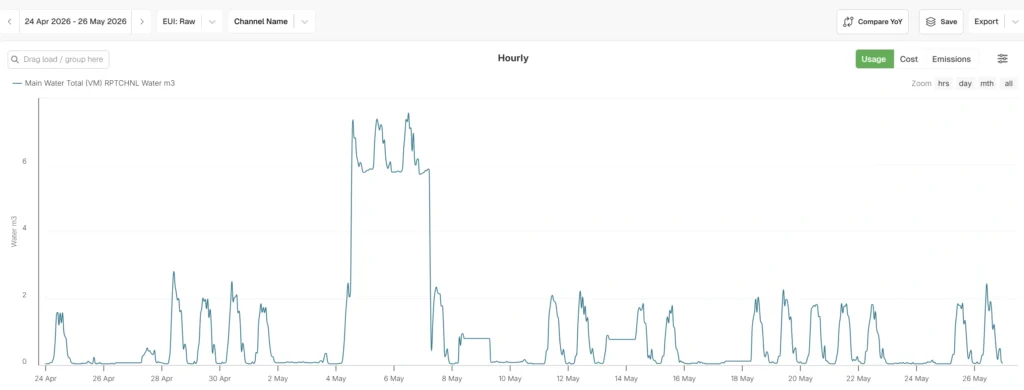
For facility and property managers, the practical result is water leaks that could cost five and six figure amounts over months become low cost events resolved in days. The graph shows how a leak was resolved in 3 days from identification to fix.
Frequently asked questions
How do I detect a water leak in a commercial building?
The fastest way is continuous interval monitoring rather than waiting for a visible leak or a high bill. Watch the overnight and weekend flow: a building that should be empty but shows steady consumption almost certainly has a leak, a stuck valve, or a plant fault. Traditional acoustic or thermal leak detection is still useful to pinpoint the physical location once monitoring has told you a leak exists, but monitoring is what catches it early, often within a day.
What is a normal overnight water base load for a commercial building?
For most offices and similar buildings, overnight and weekend flow should fall close to zero when the building is unoccupied. Any steady, continuous draw during those hours is a “base load” that usually signals waste. In real Auckland cases, persistent base loads of 580 to 1,000 litres an hour have turned out to be a failed cooling tower valve and an uncontrolled urinal, each costing tens of thousands of dollars a year until detected.
How often should commercial water meters be monitored in Auckland?
For any building of meaningful size, aim for interval monitoring at 15-minute or hourly resolution. Monthly meter reads are enough for billing but far too slow to catch leaks, after-hours flow, or plant faults, each of which is charged at both the water and wastewater rate.
How much does commercial water cost in Auckland?
For 2026/27, Watercare charges $2.14 per 1,000 litres for water supply (excl GST) plus a volumetric wastewater charge of $6.61 per kL on the moderate user plan. Because a standard office is billed wastewater on 95 per cent of supplied water, the effective all-in cost is roughly $8.40 per kL excluding GST, or close to $9.70 including GST.
Why is wastewater more expensive than water in Auckland?
Wastewater covers collection and treatment, which is more costly than supplying clean water. Watercare’s commercial wastewater volumetric rate is about three times the water supply rate, so most of a commercial building’s water bill is actually the “out”, not the “in”.
Can I claim a rebate on a commercial water leak in Auckland?
It depends on where the water went. The water supply charge itself is generally not refundable on a commercial property. However, if the leaked water never reached the wastewater network, for example a burst pipe running onto a concrete pad or to stormwater, you can apply to Watercare to have the wastewater charge on that volume credited, since it was never treated. You need evidence of the volume lost and proof it did not enter the sewer, which is where metered data matters.
Can high-frequency monitoring reduce my wastewater charges?
Yes, in two ways. It gives you the metered evidence to support a wastewater credit when a leak discharges outside the sewer rather than into it. And by sub-metering water that never enters the network, such as irrigation or cooling tower evaporation, it supports a Watercare wastewater audit to set the correct discharge percentage going forward. Since wastewater is the larger charge, both can be meaningful savings.
Does water monitoring help with NABERS NZ ratings?
Yes. NABERS NZ includes a water rating, and consistent, verified interval data is the foundation for both improving and substantiating that rating. A monitoring platform that standardises and audits the data makes rating submissions far less painful.
Sources: Watercare commercial water, wastewater and IGC charges 2026/27; Watercare “How commercial charges work”; Watercare pricing announcement, 3 June 2026.